
USMC PFT CALCULATOR
Check Your Score Against the Latest Standards
Use our USMC PFT Score Calculator to calculate your Marine Corps PFT score. Check pull-ups, push-ups, plank, and 3-mile run points with ease.
EVENT 1 — PULL-UPS / PUSH-UPS
EVENT 2 — PLANK
EVENT 3 — 3-MILE RUN
* Sample scoring formula — adjust the numbers in the JavaScript to match your official MCO 6100.13A tables.
How the USMC PFT Score Calculator Works : Check Your Score Against the Latest Standards
Use the calculator above to get your PFT and CFT score instantly. Plug in your age, gender, and event results, and you’ll see exactly where you land Class 1st, 2nd, 3rd, or unfortunately, unqualified. Everything below is here to help you understand what that number actually means, because a score on its own doesn’t tell you much if you don’t know how it fits into the bigger picture.
What Your Score Actually Means
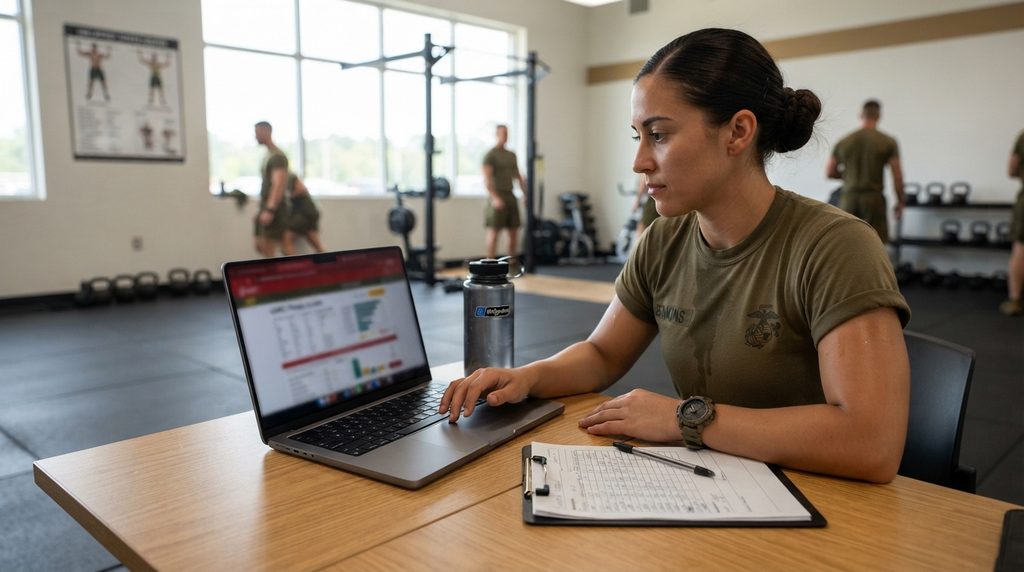
Getting a number out of a calculator is the easy part. What matters is what that number does to your career.
Every PFT and CFT you take gets converted into a class, and that class becomes a letter grade on your fitness report. Score 235 or above and you’re 1st Class that’s an “A” on your report. Land between 200 and 234 and you’re 2nd Class, a “B.” Fall between 150 and 199 and you’re still passing, but as 3rd Class, a “C.” Anything under 150 points, or under 40 points on any single event, means you didn’t qualify at all — and that’s not something you want sitting in your record.
Here’s the part most people don’t realize until it matters: your PFT and CFT scores aren’t just a box you check off once a year. They follow you. Promotion boards look at them. A string of 1st Class scores tells a very different story than a string of near-failures, even if you technically passed every time.
There’s also a reward at the top end that’s easy to miss. Score 285 or higher on both your PFT and CFT in the same testing cycle, and you qualify for a body composition exemption up to 26% body fat for men and 36% for women, no waiver paperwork required. If you’re close to that number, it’s worth knowing it exists.
Current PFT Scoring Standards by Age and Gender
Scoring works differently depending on which age bracket you fall into, and the standards get more forgiving as you get older — which makes sense, since a 45-year-old and a 19-year-old aren’t being held to the same physical baseline. Here’s a breakdown of what’s required at each bracket for the three PFT events: pull-ups or push-ups, the plank, and the run (or 5k row, if you qualify for the swap).
[Full scoring table by age bracket and gender goes here — pull-ups/push-ups, plank time, run/row time, minimum and maximum points for each]
A couple of things worth knowing before you read the table. Pull-ups and push-ups aren’t scored on equal footing — you can max out at 100 points doing pull-ups, but push-ups top out at 70, even if you crank out more reps than the max pull-up score would require. If upper-body strength is your strong suit, pull-ups are almost always the better move if you can do them.
The 5k row isn’t open to everyone. It’s reserved for Marines 46 and older, or for anyone medically cleared to swap it in — say, due to an injury or a post-partum recovery period. Everyone else runs the 3 miles.
What Changed: Old Standards vs. New Standards
If you took the PFT a few years ago and the numbers look different now, you’re not imagining it. The standards have shifted more than once recently, and it’s easy to get tripped up if you’re working off an outdated chart — or an outdated memory.
| What Changed | Old Standard | Current Standard |
|---|---|---|
| Plank max score | 4:20 | 3:45 |
| Plank min score | 1:03 | 1:10 |
| Abdominal event | Crunches allowed as alternative | Crunches removed — plank only, effective Jan 1, 2023 |
| Combat-arms minimum score | 150 points (same as everyone else) | 210 points, effective Jan 2026 |
| Body composition method | Height/weight tables | Waist-to-height ratio + body fat percentage (BIA) |
The biggest one to know about right now is the combat-arms change. If you’re in a combat-arms MOS, the old 150-point passing floor no longer applies to you — you need 210 to be considered qualified, even though the general fitness report classes (150/200/235) haven’t moved for everyone else. It’s easy to miss this if you’re just glancing at the standard score table, so if that applies to you, don’t assume “passing” means the same thing it used to.
PFT vs. CFT: How the Two Tests Work Together
It’s worth being clear about this, because a lot of people assume the PFT is the whole picture. It isn’t. The PFT and CFT are two separate tests, and you’re required to pass both, every year.
The PFT runs from January 1st through June 30th. The CFT picks up from July 1st through December 31st. Different half of the year, different test, same stakes — a failure on either one lands you an adverse fitness report and can put you in a promotion restriction until you retest and pass.
Where the PFT measures general fitness — strength, core endurance, cardio — the CFT is built around combat-specific movement: running under load in boots and utilities, lifting ammo cans overhead against the clock, and a shuttle run that mixes crawling, buddy carries, ammo resupply, and a simulated grenade throw. They’re testing different things on purpose. Passing one doesn’t tell you much about how you’ll do on the other, so it’s worth training for both rather than assuming your PFT prep has you covered.
Breaking Down Each Event
If you’ve never taken the test — or it’s been a while here’s what you’re actually walking into.
Pull-ups or push-ups. You pick one. Pull-ups can earn you up to 100 points; push-ups cap out at 70 points, no matter how many you do. If you can do pull-ups at all, it’s almost always worth training for them over push-ups purely on the score math.
Plank hold. As of January 2023, this is the only core event — crunches are gone. You’re holding a forearm plank for time, and the scoring window runs from 1:10 (minimum) up to 3:45 (maximum, for full points).
3-mile run, or 5k row. Straightforward distance test for most Marines. If you’re 46 or older, or medically cleared, the 5k row is an approved substitute — and altitude adjustments apply to both if you’re testing above 4,500 feet.
Movement to Contact (CFT). An 880-yard run done in boots and the utility uniform, not running shoes and shorts. It’s meant to simulate actually moving to a position under real conditions, not a track workout.
Ammo Can Lifts (CFT). You’re lifting a 30-pound ammo can from shoulder height to overhead, over and over, for up to two minutes. It’s a grinder of an event — shoulders and core take the brunt of it.
Maneuver Under Fire (CFT). The most complex event on either test. A 300-yard shuttle that stacks crawling, buddy drags and carries, ammunition resupply, a simulated grenade throw, and agility running into one continuous course. It rewards Marines who train movement patterns, not just raw fitness.
What Happens When You Age Into a New Bracket
Standards ease up as you move into each new age bracket — 26, 31, 36, 41, 46, and 51 are the checkpoints. That’s genuinely good news if you’re approaching one of those birthdays and feeling like your numbers have plateaued. A score that would’ve landed you 2nd Class last year might land you 1st Class once you cross into the next bracket, even with identical performance.
The catch is that it only helps if you actually check. A lot of Marines keep training and testing against the standard they memorized years ago, without realizing the bar moved in their favor. Worth running the calculator again the testing cycle after your birthday, just to see where you actually stand.
Frequently Asked Questions
What’s the minimum passing PFT score? 150 points overall, with a minimum of 40 points on each individual event. Score below 40 on even one event, and you don’t pass — regardless of how well you did on the other two.
What happens if I fail the PFT or CFT? You get an adverse fitness report, and you’ll typically be placed in a promotion restriction status until you retest and pass. It’s not just a missed workout — it follows you until it’s corrected.
Is the plank scored differently than crunches used to be? Yes. Crunches were removed as an option effective January 1, 2023. The plank is now the only authorized core event, with scoring adjusted at the same time — the maximum time dropped from 4:20 to 3:45, and the minimum rose from 1:03 to 1:10.
What’s the maximum possible PFT score? 300 points total — 100 each for the strength event, plank, and run/row. Push-ups are the one exception, capping at 70 points instead of 100.
Do altitude adjustments apply to my run time? Yes, if you’re testing at 4,500 feet or higher. Both the 3-mile run and the 5k row have separate scoring tables for altitude, since performance naturally drops in thinner air.
Who’s eligible to use the 5k row instead of the 3-mile run? Marines 46 and older, along with anyone medically authorized — due to injury or a post-partum recovery period, for example.
What’s the body composition exemption, and how do I qualify? Score 285 or higher on both your PFT and CFT in the same cycle, and you’re exempt from the standard body-fat limits, up to 26% for men and 36% for women.
How often do Marines have to take the PFT and CFT? Once a year, each. PFT happens between January and June, CFT between July and December.
What’s the actual difference between the PFT and CFT? The PFT measures general fitness — strength, core, and cardio. The CFT measures combat-specific movement and functional strength under load. They test different things, and you need to pass both.
How does my score affect my fitness report and promotion? Your point total converts to a class — 1st, 2nd, or 3rd — which becomes a letter grade on your fitness report. That grade is part of what promotion boards look at, and a pattern of low scores can hurt you even if you technically pass every time.
Did the combat-arms minimum score change in 2026? Yes. As of January 2026, Marines in combat-arms MOSs need a minimum of 210 points to be considered qualified, up from the general 150-point floor.
Are pull-ups or push-ups worth more points? Pull-ups. They cap at 100 points, while push-ups max out at 70 regardless of rep count. If pull-ups are an option for you physically, they’re almost always the stronger choice for your score.
Related Calculators
- CFT Calculator — score your Combat Fitness Test separately
- Body Composition Calculator — check your waist-to-height ratio and body fat estimate
- Height & Weight Standards — see if you fall within screening weight before body composition applies